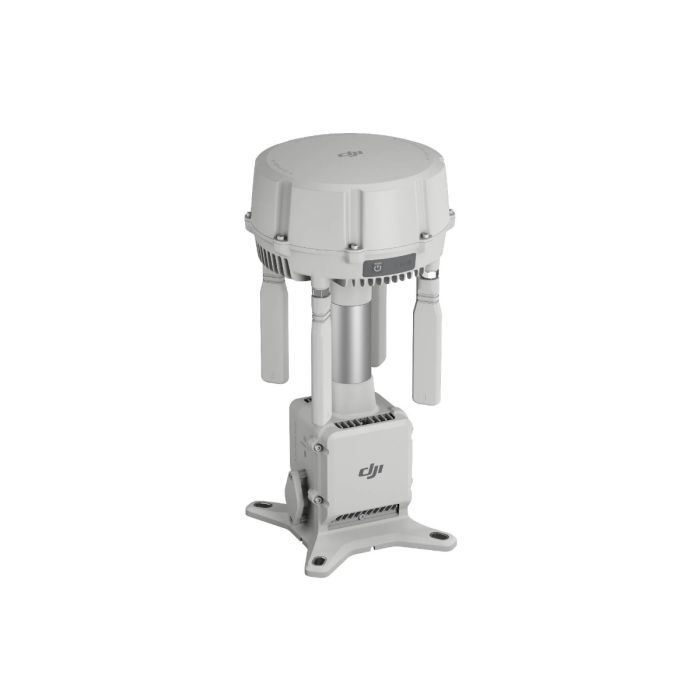
DJI O4 Ground Station
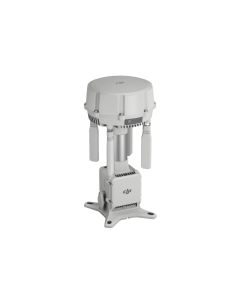
by DJIBuilt to overcome signal limits, DJI O4 Ground Station features a 12-antenna array and automatic multi-band selection. The new Gateway Mode connects directly to FlightHub 2 to bypass deployment barriers, while Relay Mode supports offline reach. Maintenance-free by design, it drives 24/7 unattended operations.
- Plaćanje na rate Plaćajte na rate Visa, Visa Premium, Maestro, MasterCard i Diners kreditnim karticama. Više detalja provjerite na linku Načini plaćanja.
- Brza dostava Za sve narudžbe unutar RH zaprimljene do 14h dostava će biti izvršena sljedećeg radnog dana*. Za cijelu Europu vršimo brzu dostavu, a više detalja provjerite na linku Načini dostave.
- Međunarodna kupnja EU tvrtke(osim RH) s valjanim VAT ID brojem plaćaju cijenu bez PDV-a. Cijena će se obračunati prilikom check out-a. Svi kupci izvan EU plaćaju izvoznu cijenu bez PDV-a.
Sadržaj pakiranja
- DJI O4 Ground Station x 1
- USB-C to USB-C Cable x 1
- Ethernet Connector x 2
- Expansion Bolts x 4
- Installation Card x 1
- Screws & Tool set x 1
Built to overcome signal limits, DJI O4 Ground Station features a 12-antenna array and automatic multi-band selection. The new Gateway Mode connects directly to FlightHub 2 to bypass deployment barriers, while Relay Mode supports offline reach. Maintenance-free by design, it drives 24/7 unattended operations.
Advanced Hardware Robust Transmission
High-Performance RF Unit
The RF unit with high-output capabilities significantly boosts signal penetration and coverage, securing reliable links through dense urban obstructions. An optimized signal-to-noise ratio (SNR) further enhances receiver sensitivity, recovering usable signals even in complex electromagnetic environments.
Omnidirectional High-Gain Antenna
Using 12 internal and external antennas with horizontal and vertical polarization, O4 Ground Station delivers omnidirectional, high-gain coverage. It can continuously and stably capture signals regardless of the aircraft's position, helping maintain a seamless communication link for wide-area operations.
Automatic Multi-band Selection
To navigate congested urban RF environments, O4 Ground Station automatically shifts across sub2G, 2.4 GHz, 5.2 GHz, 5.8 GHz, and other bands to help bypass interference. This delivers a crisp, stutter-free video feed, and when paired with DJI Matrice 400, supports a transmission range of up to 40 km.
5-System, 19-Frequency GNSS
An integrated high-gain RTK module tracks 19 frequencies across five global satellite systems. Even in challenging, semi-obstructed environments like urban canyons or dense canopies, it rapidly acquires satellite signals. This provides continuous, centimeter-level positioning data, safeguarding flight operations.
Gateway Mode Wide Coverage
Direct Network Connectivity
In Gateway Mode, O4 Ground Station connects directly to DJI FlightHub 2 via Ethernet or the DJI Cellular Dongle 2, delivering low-latency, high-bandwidth video feeds. This frees the station from DJI Dock 3's proximity constraints, allowing it to extend coverage up to 30 km.
Signal Map for Precise Deployment
After a flight, FlightHub 2 utilizes flight data to generate a Signal Map that visually highlights weak coverage zones. This helps operators position ground stations more precisely and reinforce communication links, enhancing overall flight safety.
Virtual Cockpit for Agile Control
In Gateway Mode, operators can use the FlightHub 2 Virtual Cockpit to remotely control the aircraft. Within the ground station's coverage area, pilots can manually override preset routes, enabling a flexible and fast response to multi-point task requirements.
Relay Mode, Offline Reach
High-Point Setup to Clear Obstructions
O4 Ground Station inherits the functions of the D-RTK 3 Relay Fixed Deployment Version. In offline areas such as valleys or urban environments with severe signal obstruction, operators can switch to Relay Mode and position the station at a high point to extend aircraft video transmission range.
Multi-Device Rotation for Higher Utilization
Remote controllers or DJI Docks within signal range can remotely scan and connect to O4 Ground Station. This enables fast turnarounds, as a single station can service different aircraft sequentially and improve overall hardware utilization.
Durable Design, Smart Power
All-Weather Reliability
An IP67 rating protects against water and dust, while O4 Ground Station operates reliably in temperatures from -40° to 55° C (-40° to 131° F). This robust build supports continuous, unattended operations across harsh outdoor climates.
Lightning Protection
Proprietary lightning protection components and a grounding design meet the EN/IEC 61643-21 Category C standard. This helps mitigate the risk of lightning damage when deploying the station at elevated outdoor locations such as mountains or transmission towers.
Maintenance-Free Design
Fanless passive cooling and a self-recovery mechanism allow the station to automatically resume operation after power outages or software anomalies. This maintenance-free design reduces the need for manual on-site reboots and helps cut troubleshooting trips and operational costs.
Smart Low-Power Mode
In Gateway Mode, O4 Ground Station features smart power management. It automatically hibernates when no aircraft is connected, drawing only 7 W on standby. For off-grid environments, the station connects to DJI Power solar solutions or third-party photovoltaic systems, supporting long-term operations in remote areas.
Supported Models
Gateway Mode:
DJI Dock 3
Relay Mode:
DJI Dock 3
DJI Matrice 400
DJI Matrice 4E
DJI Matrice 4T
DJI Matrice 4D (DJI RC Plus 2 Enterprise)
DJI Matrice 4TD (DJI RC Plus 2 Enterprise)
| GNSS Receiver | |
| GNSS Frequency | GPS: L1C/A, L2C, L5 |
| BDS: B1I, B2I, B3I, B1C, B2a, B2b | |
| GALILEO: E1, E5a, E5b, E6 | |
| GLONASS: L1, L2 | |
| QZSS: L1C/A, L2C, L5 | |
| L-Band | |
| System Accuracy | Single Point Accuracy (Uncalibrated): |
| Horizontal: 1.5 m (RMS) | |
| Vertical: 3.0 m (RMS) | |
| Satellite-Based Differential Accuracy: | |
| Convergence Time: 20 min | |
| Horizontal: 30 cm (RMS) | |
| Vertical: 40 cm (RMS) | |
| Network RTK Calibration: | |
| Horizontal: 1.0 cm (RMS) + 1 ppm | |
| Vertical: 3.0 cm (RMS) + 1 ppm | |
| Video Transmission | |
| Video Transmission System | DJI O4 Enterprise Enhanced Video Transmission System |
| Operating Frequency and Transmitter Power (EIRP) | 902 MHz to 928 MHz: < 30 dBm (IC), < 16 dBm (MIC) |
| 1.430 GHz to 1.444 GHz: < 35 dBm (SRRC) | |
| 2.400 GHz to 2.4835 GHz: < 33 dBm (IC), < 20 dBm (CE/SRRC/MIC) | |
| 5.150 GHz to 5.250 GHz: < 23 dBm (IC/CE) | |
| 5.725 GHz to 5.850 GHz: < 33 dBm (IC), < 14 dBm (CE), < 30 dBm (SRRC) | |
| Operating frequency allowed varies among countries and regions. Refer to local laws and regulations for more information. | |
| Max Transmission Distance (unobstructed, free of interference) | IC |
| 1. Between Matrice 400 and O4 Ground Station: 40 km | |
| 2. Between other aircraft and O4 Ground Station: 30 km | |
| 3. Between the remote controller/DJI Dock 3 and O4 Ground Station (Relay Mode): Recommended within 1 km; maximum 3 km (unobstructed, free of interference) | |
| SRRC | |
| 1. Between Matrice 400 and O4 Ground Station: 25 km | |
| 2. Between other aircraft and O4 Ground Station: 18 km | |
| 3. Between the remote controller/DJI Dock 3 and O4 Ground Station (Relay Mode): Recommended within 1 km; maximum 3 km (unobstructed, free of interference) | |
| CE | |
| 1. Between Matrice 400 and O4 Ground Station: 25 km | |
| 2. Between other aircraft and O4 Ground Station: 18 km | |
| 3. Between the remote controller/DJI Dock 3 and O4 Ground Station (Relay Mode): Recommended within 300 m; maximum 1 km (unobstructed, free of interference) | |
| Max Transmission Distance (unobstructed, with interference) | Strong Interference (Dense Buildings, Residential Areas, etc.): approx. 1.8 to 6 km |
| Medium Interference (Suburban Areas, City Parks, etc.): approx. 6 to 18 km | |
| Weak Interference (Open Spaces, Remote Areas, etc.): approx. 18 to 40 km | |
| Data is tested with Matrice 400 under IC standards in unobstructed environments of typical interference. Only to serve as a reference and provides no guarantee as to the actual flight distance. | |
| Max Transmission Distance (obstructed, with interference) | Low Interference and Obstructed by Buildings: approx. 0 to 0.5 km |
| Low Interference and Obstructed by Trees: approx. 0.5 to 3 km | |
| Data is tested with Matrice 400 under IC standards in obstructed environments of typical interference. Only to serve as a reference and provides no guarantee as to the actual flight distance. | |
| Antenna | OcuSync 4 Pro external directional antenna × 4 |
| OcuSync 4 Pro internal directional antenna × 8 | |
| 2.4G/5.2G/5.8G: 2T4R | |
| Sub2G: 2T2R | |
| The antenna uses a standard reverse polarity SMA connector. | |
| Network Access | Ethernet Access: Adaptive Ethernet port; requires ≥ 100Mbps bandwidth and ≤ 100ms latency |
| 4G Access: Requires the DJI Cellular Dongle 2 | |
| Electrical Properties | |
| Power Interface | Ethernet Port (PoE) |
| WAN: PoE-in | |
| LAN: PoE-in | |
| Ethernet Cable Requirements | Cat 6 or above outdoor-rated, waterproof twisted-pair cable; max length 100 m; outer diameter 5.5 to 6.5 mm |
| Power Consumption | Gateway Mode: |
| 1. Max Power Consumption (Including Heating): 65 W | |
| 2. Typical Power Consumption (Without Heating): 17.1 W | |
| 3. Low-Power Mode: 7 W** | |
| Relay Mode: | |
| 1. Max Power Consumption (Including Heating) : 65 W | |
| 2. Typical Power Consumption (Without Heating): | |
| - With DJI Dock 3/DJI Matrice 4 Series: 31.7 W | |
| - With DJI Matrice 400: 37.9 W | |
| 3. Power Consumption (No Aircraft Connected): | |
| - With DJI Dock 3/DJI Matrice 4 Series: 29.7 W | |
| - With DJI Matrice 400: 30.6 W | |
| * Measured in a controlled test environment and should be used for reference only. Actual power draw may be higher when accounting for losses in the power supply. | |
| ** Low-power mode is not recommended for use at temperatures of -40° to -20° C (-40° to -4° F). | |
| Supported Power Supply | 1. DJI Dock 3 PoE Output Port |
| 2. Third-party PoE Power Supplies: | |
| IEEE 802.3bt Type 4 (PoE++): 52 V to 57 V output, max 99.9 W per port; operating range -40° to 55° C (-40° to 131° F) | |
| IEEE 802.3bt Type 3 (PoE++): 50 V to 57 V output, max 60 W per port; operating range -30° to 55° C (-22° to 131° F) | |
| IEEE 802.3at Type 2 (PoE+): 50 V to 57 V output, max 30 W per port; operating range -20° to 55° C (-4° to 131° F) | |
| Non-standard PoE or Type 1 power supplies are not supported; the device will show a solid red indicator light if an unsupported supply is connected. | |
| Type 2 supports Gateway Mode only. | |
| Backup Battery | LiPo |
| Capacity: 3250 mAh | |
| Energy: 23.4 Wh | |
| Backup Battery Operating Time (at room temperature) | Battery preservation mode is enabled by default when powered via PoE. In the event of a sudden power loss, estimated runtime is: |
| Gateway Mode: approx. 45 min | |
| Relay Mode: approx. 30 min | |
| Battery preservation mode: when powered via PoE, the system keeps battery voltage between 7.0 V and 7.4 V. If the battery voltage at insertion exceeds 7.5 V, the system will discharge it to the safe threshold before entering preservation mode; the battery will not charge to full capacity. | |
| Battery discharge performance may decrease in low temperatures, reducing actual operating time. | |
| Backup Battery Charging | Supports 9V or 12V PD charging. DJI 65W Portable Charger is recommended before deployment. When fully charged, estimated runtime in Gateway Mode is approx. 2 hours. |
| Charge time (65W PD): approx. 2.5 hours | |
| Charging with a 5V charger is only supported when the device is powered off. | |
| Charging is only supported when the battery cell temperature is between 0° and 55° C (32° and 131° F). | |
| Physical Characteristics | Ethernet Port Surge Protection |
| WAN/LAN Ports: Ethernet interface supports up to 10kA (total discharge current) surge protection, meeting EN/IEC 61643-21 Category C. | |
| Operating Temperature | IEEE 802.3bt Type 4 (PoE++): -40° to 55° C (-40° to 131° F) |
| IEEE 802.3bt Type 3 (PoE++): -30° to 55° C (-22° to 131° F) | |
| IEEE 802.3at Type 2 (PoE+): -20° to 55° C (-4° to 131° F) | |
| The 55° C (131° F) upper limit accounts for solar radiation. At -40° C (-40° F), the device requires a windless environment; auto-restart after shutdown is not supported in windy conditions. Cold-weather heating startup requires IEEE 802.3bt Type 3 (PoE++) or above. | |
| After storage or operation in extreme temperatures, allow the internal backup battery to return to between 0° and 45° C (32° and 113° F) before charging. | |
| PoE Auto Wake-Up | When connected to a Type 2 or higher PoE power supply, the device supports automatic wake-up on cable insertion or power restoration. |
| Cold-Weather Heating Startup | In environments from -40° to -20° C (-40° to -4° F), the device can start up via cold-weather heating mode when powered by a PoE supply of 60 W or above. |
| Requires PoE supply of IEEE 802.3bt Type 3 (PoE++) or above. | |
| Altitude | 6000 m |
| Ingress Protection Rating | IP67 |
| Impact Protection Rating | IK07 |
| Dimensions | 170×170×352 mm (L×W×H) |
| Weight | 2.68 kg |
| Mounting | Expansion Bolt Mounting: φ6×70 mm |
| M6 Screw Mounting: 60 mm hole center spacing | |
| Supported Software | |
| Applications | DJI Enterprise app (used with Android phones for deployment and commissioning) |
| Cloud Platform | FlightHub 2 |
| FlightHub 2 On-Premises Version | |
| FlightHub 2 FlightHub Sync | |
| DJI Cloud API | |
| External Device Support | Supports cameras using ONVIF and GB/T 28181 protocols |
| Supports up to 4 simultaneous 1080p H.264 video streams | |
| Open Ecosystem | ESDK 2.0 |
- Novo

- Novo